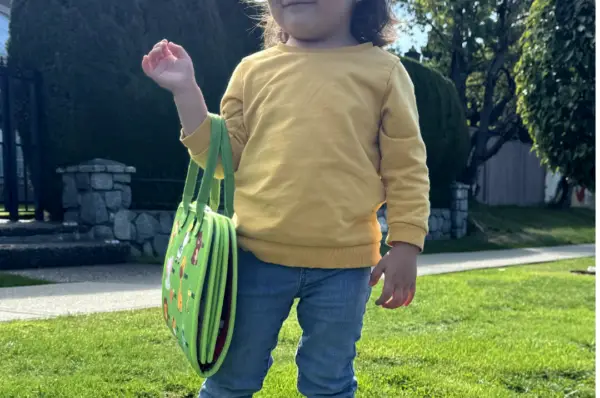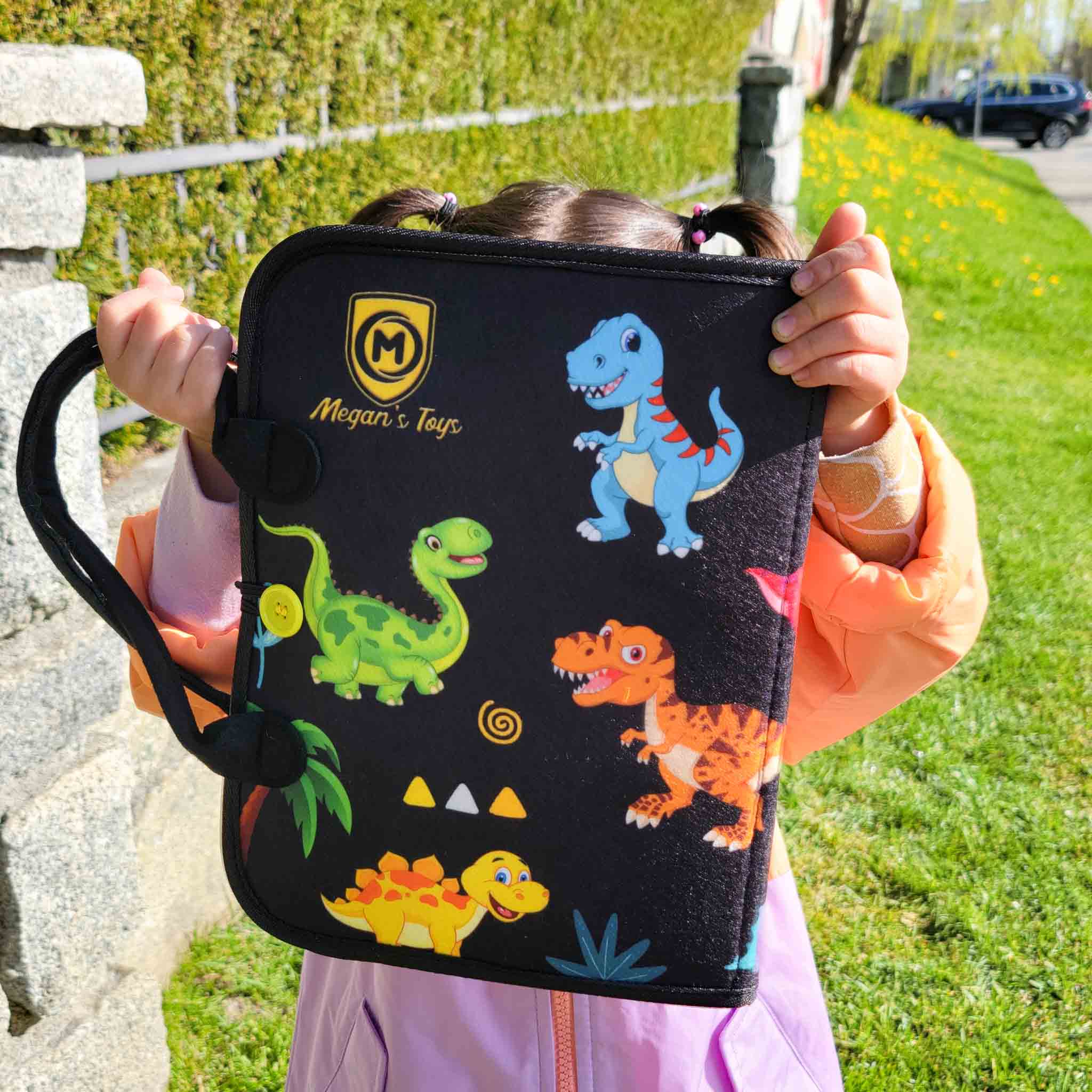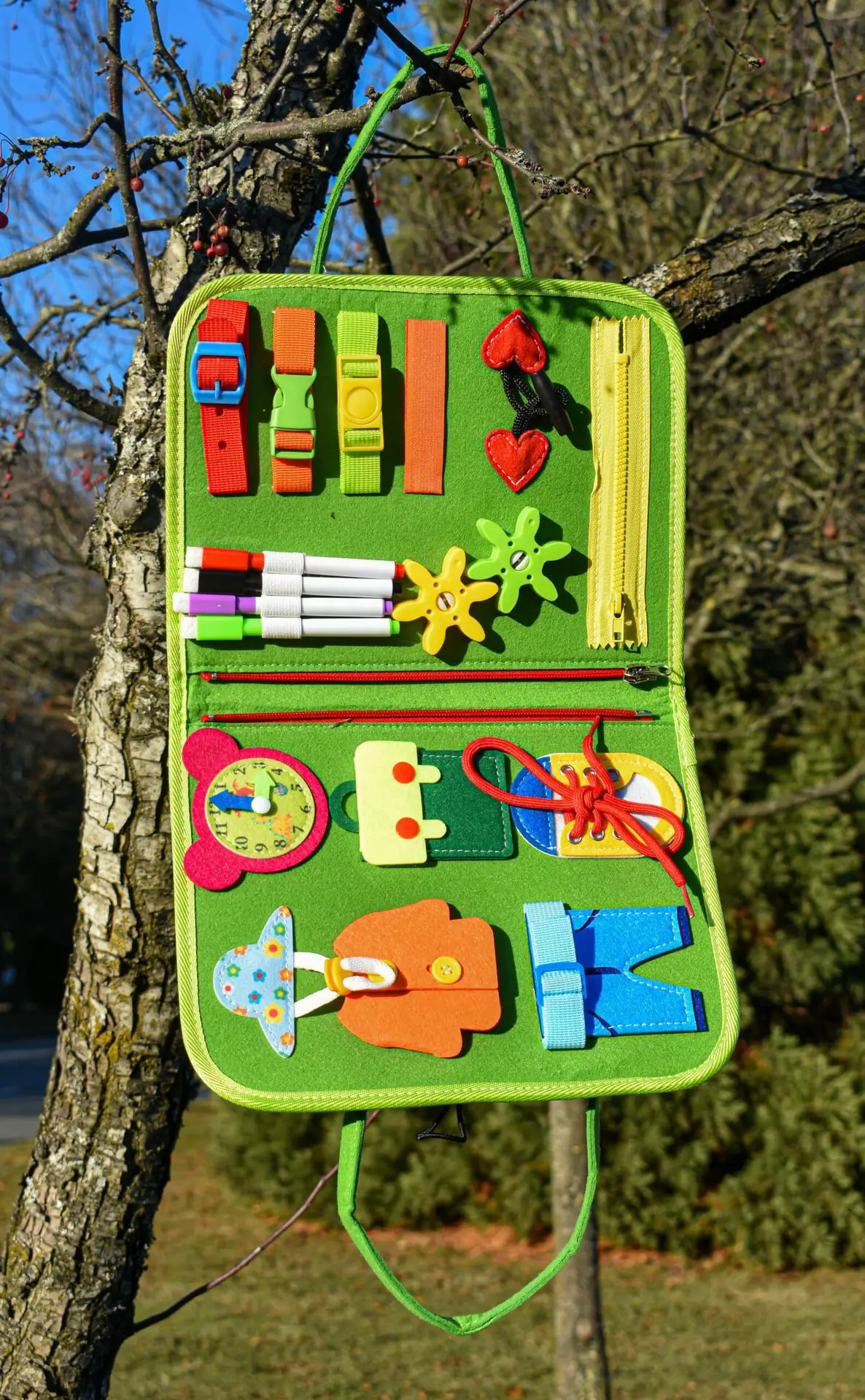
A church busy book is a soft, silent activity book designed to be used during a service. It gives a toddler something to do with their hands in the pew — matching, sequencing, moving felt pieces — while the activities themselves teach what is happening at the altar. It is a Mass bag in book form.
Parents rarely buy one because they want another toy. They buy one because Sunday has started to feel like something to survive, and a busy book is the smallest change that makes the hour workable. We make Catholic felt busy books at Megan’s Toys, and this is the honest version of what they do and do not fix.
What makes a church busy book different from a regular quiet book?
Three things, and only one of them is the religious content.
- It is engineered to be silent. A regular busy book can have crinkle paper, bells, snaps and loud velcro. A church busy book uses felt-on-felt or soft-hook fastenings, because a ripping sound in a quiet church is worse than a bored child.
- The activities mirror the liturgy. Vestment colours, the altar setup, the parts of the Mass, the sign of the cross, the rosary. The child’s hands are busy with the same thing their eyes are watching.
- It is sized for a pew and a nappy bag. Compact, self-contained, and with pieces that stay attached rather than rolling three rows forward at the Consecration.
That last point is why several popular designs — including Brother Francis’s eight-page felt book — fold into a briefcase shape with a handle, so the child carries their own “Mass bag” in.
Why do parents swear by church busy books?
It occupies hands without occupying attention
This is the mechanism that matters. A toddler who is asked to sit still with nothing to do will generate their own activity, and it will be loud. A busy book absorbs the fidgeting into something quiet, which is a very different thing from distracting the child. Fine-motor work — pinching, threading, fastening — is unusually calming for exactly the age group that struggles most in the pew.
It teaches the Mass instead of competing with it
A phone pulls a child out of the room. A busy book keeps them in it. When the priest changes vestments and your four-year-old already has a page about vestment colours, the service becomes something they can spot rather than sit through. Catholic parenting writers make this point repeatedly: the goal is not a silent child but a child who is forming a relationship with the Mass, and quiet faith-based materials serve that goal in a way a snack cup does not.
It lowers the dread
The most common thing parents tell us is not about the child at all. It is that they stopped negotiating about whether to go. When there is a plan for the hard forty minutes, the decision gets easier, and going consistently is what actually builds the habit. Consistency beats a perfect Sunday.
What age is a church busy book for?
Roughly 18 months to 6 years, with the peak between 2 and 5. Under 18 months, the book is a texture toy — still useful, but choose a version with nothing detachable, since US regulation 16 CFR Part 1501 bans small parts in products intended for children under three. From about six, children usually prefer a children’s missal or a Mass journal they can write in.
If you have children on both sides of that line, the older child often ends up teaching the younger one the pages, which is its own small win.
What is inside a good Mass busy book?
Look for pages that map onto something the child can physically see happening. Our Mass Busy Board — Catholic Felt Book is built around that idea: felt pages, non-toxic materials, sized to carry, and activities tied to the liturgy rather than generic shapes and colours. Strong page ideas across the category include:
- Setting the altar — candles, chalice, paten, missal placed in order
- Vestment colours matched to the liturgical season
- The parts of the Mass in sequence
- Sign of the cross, step by step
- A felt rosary to move bead by bead
- Church building and stained-glass puzzles
What to avoid: pages with five unrelated activities crammed together, anything with a sound chip, and glued-on felt, which peels within a month of real handling. Stitched pieces last years.
Church busy book vs snacks, toys and phones: what actually works at Mass?
| Option | Quiet? | How long it lasts | Downside |
|---|---|---|---|
| Church busy book | Yes — felt on felt | 20–40 min, longer if new pages are held back | Costs more than the alternatives; needs to stay special |
| Snacks | Mostly | 5–10 min | Crumbs, wrappers, and it runs out fastest |
| Regular toys from home | No | 10–15 min | Rolls, clatters, invites sibling negotiation |
| Phone or tablet | Only with headphones | Whole service | Removes the child from the room entirely; hardest habit to reverse |
| Children’s missal | Yes | Varies | Needs reading ability — better from about age 5–6 |
| Nothing | Rarely | — | Works for some children; not most under-fives |
How do you introduce one so it keeps working?
The single biggest mistake is letting the book live in the toy box. It stops being interesting by week three. What works, based on what our customers report back:
- Church only. The book goes in the bag on Saturday night and comes out in the pew. Scarcity is doing half the work.
- Introduce it once at home, calmly. Name the pieces together so the first exposure is not in a crowded church.
- Sit near the front. Counterintuitive, but children behave better when they can actually see what is happening — a tip that comes up in almost every Catholic parenting guide.
- Hold pages back. If the book has a detachable set, keep one activity out of rotation for a month.
- Adjust what success means. A successful Mass is the one you attended together, not the silent one.
Do church busy books work outside Catholic Mass?
The generic pages do — Noah’s ark, creation, the Good Samaritan, church buildings, praying hands. The specifically Catholic pages, like vestments and the parts of the Mass, will not map onto a non-liturgical service. If you attend a Protestant church, look for a Bible-story busy book rather than a Mass book, or use one of our general felt busy board activities and simply reserve it for Sunday.
For families who want the broader background on why Catholic and Protestant materials differ in the first place, our post on why the Catholic Bible has extra books is a useful companion read, and our Montessori soft book guide covers how to judge whether a felt book is genuinely well designed.
Frequently asked questions
What is a church busy book?
A church busy book is a soft felt activity book made to be used quietly during a service. Its pages mirror what happens at the altar — vestment colours, setting the altar, the parts of the Mass — so a toddler’s hands stay busy while they follow along rather than tuning out.
Is a church busy book the same as a Mass quiet book?
Yes, in practice. “Mass quiet book,” “church busy book” and “Mass busy book” are three names for the same product. Quiet book emphasises the silent felt format, busy book emphasises keeping hands occupied, and Mass book signals the Catholic liturgical content.
At what age should we start using one at Mass?
Most families start between 18 months and 2 years, when sitting still stops being possible and before phone habits form. Children under three need a version with no small detachable parts. Around age five or six, many children graduate to a children’s missal instead.
How long will a busy book keep a toddler occupied?
Expect 20 to 40 minutes if the book is reserved for church only. Used daily at home, that drops sharply within a few weeks. Keeping one or two activities out of rotation and reintroducing them later is the simplest way to extend its useful life.
Is a church busy book a good baptism or First Communion gift?
It is one of the most practical faith gifts you can give, because it gets used weekly rather than displayed. For baptisms, the recipient grows into it at around 18 months. For First Communion, a child’s missal is usually the better fit, since most seven-year-olds have outgrown felt pages.
Can you wash a felt Mass busy book?
Spot-clean it rather than machine washing. Blot with a barely damp cloth and a drop of mild soap, then air-dry flat. Washing machines distort felt and loosen stitched pieces. Store the book flat in the Mass bag so pages do not crease permanently.