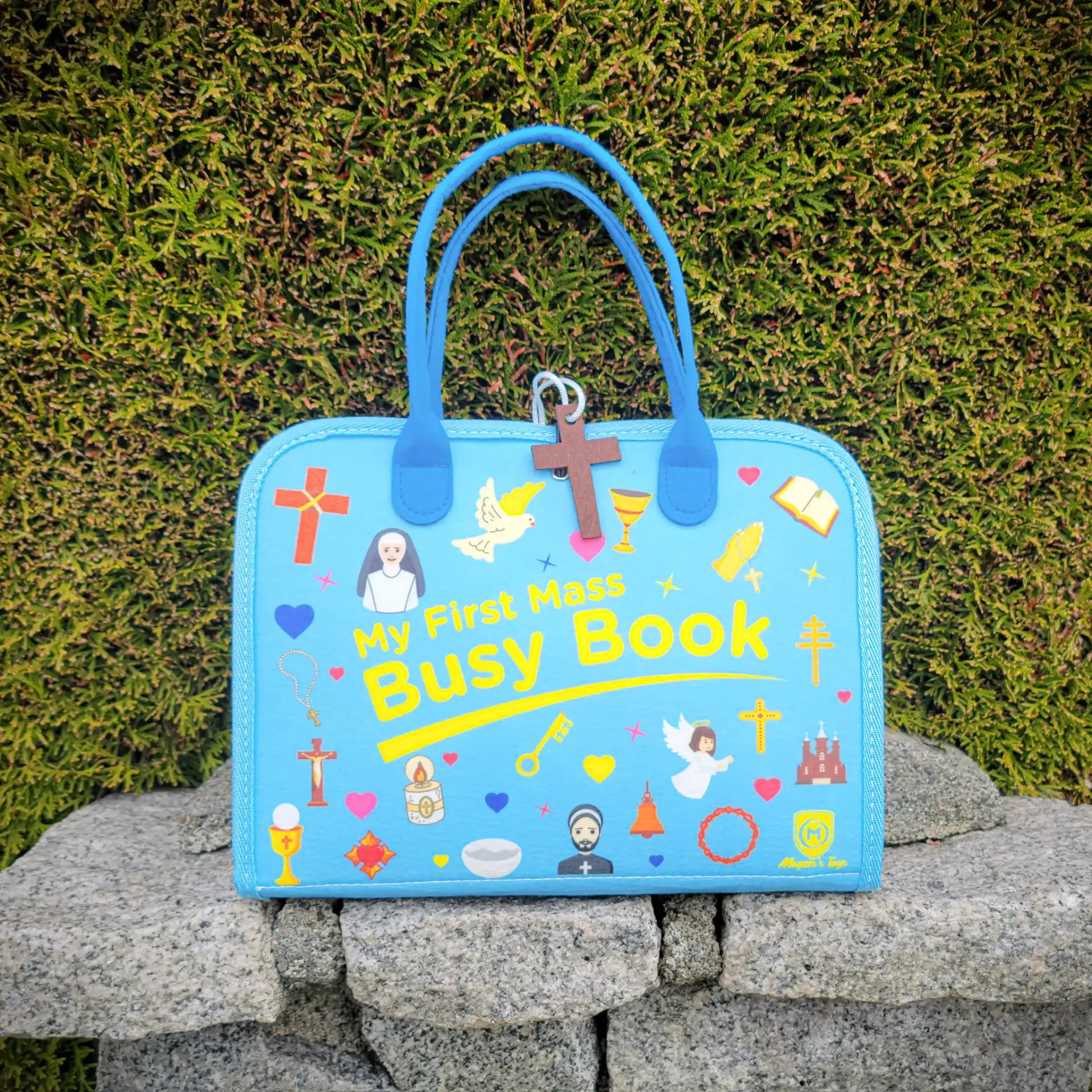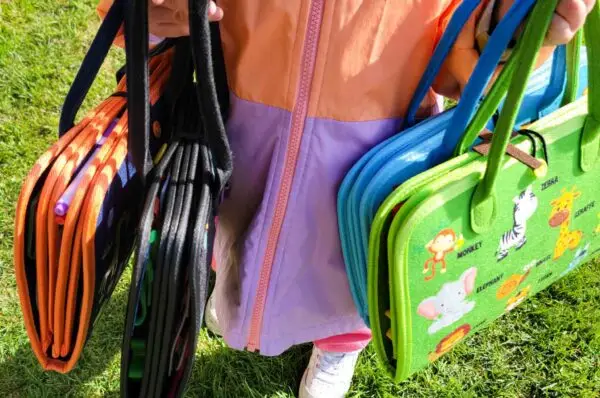
Before you buy a custom name busy board, check eight things: what it is made of, how many activity pages it has, whether pieces are stitched or glued, how the name is attached, the age range, small-part safety, the turnaround time, and the maker’s spelling-confirmation process. Those eight decide whether it lasts years or weeks.
We handmake personalised busy boards, which means we also see the ones that come back, the messages that start “the letters fell off,” and the orders where a name was spelled from a checkout note instead of a confirmed proof. Here is what to actually look at on a listing.
What is a custom name busy board?
It is a multi-page activity board or soft book with your child’s name built into the design — usually on the cover, sometimes as a removable letter-matching activity. The pages hold practical-life tasks: zips, buttons, buckles, laces, shape sorting, counting, colour matching. The personalisation is not decoration; the name is the reason the child picks it up first.
If you are still at the “what even is this” stage, start with our overview of custom name busy boards for kids and come back here when you are ready to compare listings.
What should you check before you buy a custom name busy board?
| Check | Why it matters | Red flag on a listing |
|---|---|---|
| 1. Material | Felt is quiet, light and travel-friendly; wood is sturdier but heavy and loud | “Mixed materials” with no photos of the back of a page |
| 2. Page count | Sets the price and how long it holds interest | Page count buried or counted including the cover without saying so |
| 3. Stitched vs glued | Glue peels within weeks of real toddler handling | No close-up photo of an edge or seam |
| 4. How the name attaches | Removable letters teach spelling but can be lost; sewn-on lasts forever | Letters shown “for illustration” only |
| 5. Age range | A 12-page board overwhelms a 12-month-old | “0–6 years” — nothing works for that whole span |
| 6. Small parts | Legal and choking-hazard issue for under-threes | No age warning at all on a listing with loose pieces |
| 7. Turnaround | Handmade means a queue; birthdays do not move | Only “shipping time” quoted, with no make time |
| 8. Spelling confirmation | Personalised items are usually non-returnable | Name taken from a free-text box with no proof sent |
Material: felt or wood?
Wooden busy boards are what most people picture — a plywood panel with latches, switches and locks. They are excellent at home and terrible everywhere else: heavy, noisy, and impossible to pack. Felt boards fold, weigh almost nothing and make no sound, which is why they dominate the travel, church and waiting-room use cases. If the board will mostly live in one room, wood is fine. If it needs to go in a bag, choose felt.
Page count and activity density
More pages is not automatically better. The Montessori argument against busy books — made clearly by Montessori for Today — is that most of them cram several unrelated concepts onto one page, which fragments attention instead of building it. Count the concepts per page, not the pages. One clean idea per page with a built-in control of error beats a busy collage every time.
For scale: our 12-page Montessori busy board is a full set for a 3–5 year-old, while the smaller Dino board suits a first busy board around 18 months to 3 years without overwhelming. The Animals Cover board sits between the two.
How the name is attached
There are three approaches and they are not equivalent:
- Sewn onto the cover. Permanent, indestructible, but purely decorative — the child cannot manipulate it.
- Removable felt letters with a matching outline. The best educational option: the child rebuilds their own name against a printed silhouette, which is a genuine control of error. Losing a letter is the trade-off.
- Printed or embroidered on a tag. Cheapest to produce, weakest impact. Fine for a stocking filler, disappointing as a main gift.
If you want the educational value, ask specifically whether the letters detach and whether there is an outline underneath. Many listings show removable-looking letters that are actually sewn down.
What age is a custom name busy board best for?
The personalisation lands hardest between ages 3 and 5, and there is a reason for that timing. Babies respond to their spoken name from around 9 to 12 months, but written-name recognition arrives much later: Bloodgood’s 1999 study in Reading Research Quarterly found preschoolers aged 3 to 4 learn the letters in their own name earlier and faster than any other letters, and a later study of 3,546 preschoolers by Welsch, Sullivan and Justice (2003) linked name-writing ability to broader print awareness and later reading skill.
Practically, that means:
- 12–24 months: buy for the textures and fastenings; the name is for the parents and the photos. No loose small parts.
- 2–3 years: the child recognises the name as “mine” as a shape, before knowing the letters.
- 3–5 years: peak value. Letter matching, first-letter recognition, rebuilding the name independently.
- 5+: still enjoyed, but as a quiet-time object rather than a learning tool.
Buying for a first birthday? A personalised board is a gift the child grows into over two years, which is either the best or worst thing about it depending on your expectations. Our comparison of personalised name books vs busy boards breaks down which format suits which age.
Is a personalised busy board worth the extra money?
Personalisation typically adds $8–$20 to a felt board and more to wood. It is worth it in two situations and not in a third.
Worth it when the board is a gift — a name turns a generic toy into a keepsake, and grandparents notice. Also worth it when the child is 3 to 5, because the name becomes an actual literacy activity rather than a label.
Not worth it when the board will be shared between siblings or passed down. A name locks the item to one child, and resale value on personalised handmade goods is close to zero. If you have a second baby coming, buy the unpersonalised version and spend the difference on more pages.
What are the safety red flags?
US rules are specific and useful as a buying filter. Under 16 CFR Part 1501, children’s products intended for children under three that contain small parts are banned, and the current toy safety standard is ASTM F963-23, effective 20 April 2024. Toys containing small parts must carry a choking-hazard warning.
One useful detail for felt specifically: pieces of fabric, yarn, fuzz or string liberated during use-and-abuse testing are not counted as small parts under that rule. That is why a well-made felt board can be genuinely appropriate for a young toddler in a way a wooden board with knobs and beads often is not. The risk in felt boards is not the felt — it is the buttons, beads and plastic buckles sewn onto it.
Check for: an explicit age recommendation, close-up photos of every fastening, non-toxic material statements, and rounded rather than raw-cut corners on any rigid parts.
How long does a custom busy board take to make?
Handmade personalised boards generally need 1–3 weeks of make time before shipping, and that gap widens sharply from late October through December and again around Easter. The listing’s “shipping time” is not the same number. If you have a fixed date, ask the maker for a cut-off date in writing rather than assuming.
Also ask what happens if the name is misspelled. Personalised items are usually excluded from standard returns, so the meaningful protection is a proof or spelling confirmation before cutting — including capitalisation, accents and hyphens. Long names are worth flagging too: anything over about eight letters may need a smaller letter size or a two-line layout, and it is better to know that before the board arrives.
For gift ideas beyond boards, our roundups of personalised name gift ideas for kids and our custom name baby book guide cover the adjacent options.
Frequently asked questions
What should I look for in a custom name busy board?
Check the material, page count, whether pieces are stitched or glued, how the name attaches, the stated age range, small-part safety, the make time before shipping, and whether the maker confirms spelling before cutting. Stitched felt with removable name letters and one concept per page is the strongest combination.
What age is a custom name busy board for?
Ages 3 to 5 get the most from the personalisation, because that is when children start recognising the letters in their own name. Younger toddlers from about 18 months still benefit from the fastenings and textures, but the name matters more to the adults than to them.
Are custom busy boards safe for children under three?
They can be, if the board has no small detachable parts. US rules ban small parts in products intended for under-threes, and loose fabric fibres are excluded from that definition — so a stitched felt board is usually safer than a wooden one with beads. Always check for an explicit age warning.
How much should a custom name busy board cost?
Handmade felt boards typically run $25–$100 depending on page count, with personalisation adding roughly $8–$20. Anything far below that range is usually mass-produced with glued pieces. Compare on pages and construction rather than headline price alone.
Can I return a personalised busy board?
Usually not, because it cannot be resold. That makes the spelling-confirmation step the real safeguard. Send the name exactly as you want it — capitalisation, accents, hyphens included — and ask for confirmation in writing before production starts.
How far ahead should I order for a birthday?
Allow three to four weeks: one to three weeks of make time plus shipping. Order six weeks ahead for November and December birthdays, when handmade queues are longest. Ask the maker for a written order cut-off date rather than relying on the listing’s shipping estimate.